Andy Warhol (1928-1987) was an American artist and filmmaker. One of the most influential artists of the second half of the 20th century, he worked in various media—painting, filmmaking, photography, publishing, and performance art. A leader in the pop art movement, Warhol’s work explores the relationship between advertising, consumerism, mass media, and celebrity culture, transforming everyday consumer goods and familiar icons into artworks. His embrace of mechanical reproduction challenged traditional boundaries between high and low culture. Warhol is credited with popularizing the expression “15 minutes of fame.”
Born Andrew Warhola, he was the youngest of three children in a family in the working-class neighborhood of Oakland, in Pittsburgh, Pa. He shortened his last name after moving to New York and following his graduation with a degree in Pictorial Design from the Carnegie Institute of Technology (now Carnegie Mellon University) in 1949.
He made his home and studio in New York City, getting top assignments as a commercial artist for clients including Columbia Records, Glamour magazine, Harper’s Bazaar, NBC, Tiffany & Co., and Vogue. He also designed window displays for exclusive department stores.
After establishing himself as an acclaimed graphic artist, Warhol turned to painting and drawing in the 1950s. By 1952, he had his first solo exhibition at the Hugo Gallery. As he matured, his paintings incorporated photo-based techniques, which were then used for commercial illustration. The Museum of Modern Art (MOMA) included his artwork in his first group show in 1956.
A skilled social networker, Warhol gained fame one connection at a time to become a globally recognized brand. Decades before widespread reliance on portable media devices, he documented his daily activities and interactions on his traveling audio tape recorder and Minox 35EL camera. Predating the hyper-personal apps on our smartphones, Warhol captured life and broadcast it via his work to a wide, receptive audience.
The Albany Museum of Art has works by Warhol in its collection.
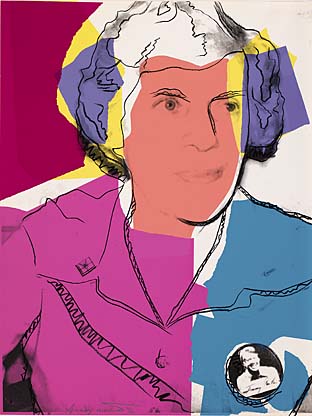
Miss Lillian is a screenprint that depicts the mother of former U.S. President Jimmy Carter.
Campbell’s Tomato Soup is a serigraph on a shopping bag.
Hand-colored Flowers is a set of 10 silkscreen and watercolor works in a project he completed with his assistant Ronnie Cutrone. Warhol had Cutrone find pictures of flowers and flower arrangements to use in the prints. Warhol then produced a series of freehand drawings based on the images, which were then transferred onto silkscreens and printed. Finally, Warhol and Cutrone hand-painted each print using watercolors. These works are unusual for Warhol because they reveal the artist’s hand. Warhol was notorious for not being directly involved with the production of his art. His studio was called “The Factory” for this reason. The prints show Warhol’s incredible talent as a draughtsman.