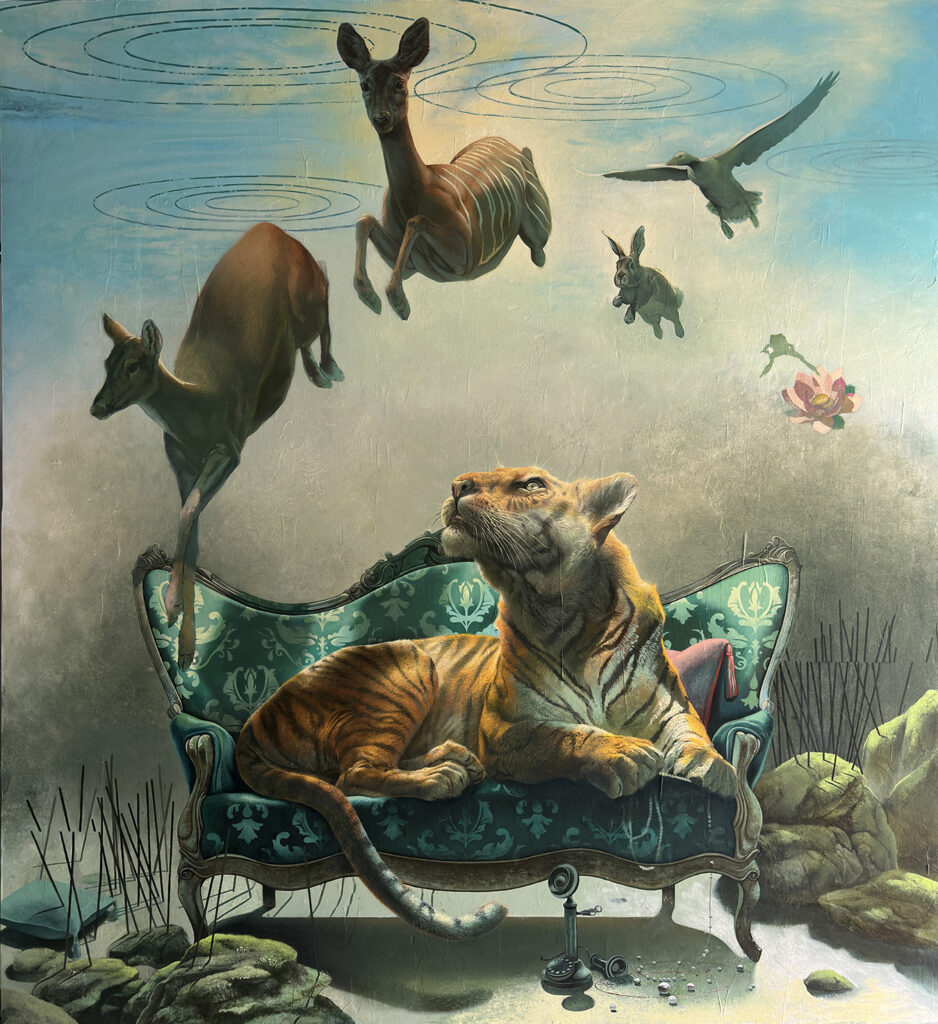
The paintings of O.M. Norling invite viewers into a world where memory, instinct, and imagination coexist. At first glance, his meticulously rendered compositions appear to belong to the tradition of still life, yet they resist conventions of the genre. Tigers recline on silk Victorian settees, dueling ibex are ensnared with teapots and bicycles, a moose balances atop a delicate Regency-era bench, while wolves, manatees, foxes, rhinoceroses, and mallards occupy carefully staged environments filled with furniture, domestic objects, and relics from another era. These elements combine to form visual riddles that ask not to be solved, but experienced. Rather than illustrating a singular narrative, each painting becomes an open-ended meditation on the complexity of being human.
This exhibition, Artifacts of a Fate That Never Was, proposes that these enigmatic scenes are not simply imagined worlds, but artifacts recovered from the liminal space between waking life and dreams. Norling envisions consciousness as a dialogue between two selves: the person we inhabit each day and the one who emerges in sleep. As the conscious mind yields to the subconscious each night, it sends a metaphorical “letter” recounting the events of waking life.
The response returns in fragments, images, impressions, symbols, and emotions that can be illuminating, unsettling, humorous, or impossible to decipher. Norling asks viewers to imagine these two states existing simultaneously, separated only by a translucent veil—the waking self residing beneath the surface of water, and the dreaming self drifting above in the open air. The paintings become traces of that impossible meeting point, revealing the subtle yet profound ways our dreams shape our waking lives and our waking lives, in turn, shape our dreams.
A self-taught American painter living in Decatur, Ga., Jay Wilson paints under the pen name O.M. Norling, a tribute to his great-great-grandfather Olaf Magnus Norling. The story behind the name is as compelling as the paintings themselves. In 1843, Norling disappeared from his family’s farm outside Gothenburg, Sweden, leaving no trace for seven years until a letter finally arrived from America. Driven by an irresistible compulsion to seek a new life, he had crossed the Atlantic as a stowaway aboard a ship bound for New Orleans. For Wilson, this remarkable act of courage has become both inspiration and inheritance. By signing his paintings with his ancestor’s name, he honors a legacy of conviction and risk while acknowledging the unseen threads that connect generations.
Wilson’s own journey toward becoming the artist O. M. Norling mirrors this spirit of quiet audacity. Although drawing and painting had been lifelong interests, he initially resisted considering art as a serious vocation. It was fatherhood that transformed a private dream into an obtainable goal. At age 35, with two young sons and one on the way, Wilson confronted a question that became a cutting imperative: how could he encourage his children to pursue their dreams if he was unwilling to pursue his own? The answer came not through dramatic reinvention, but through discipline and persistence. Rising at 4 am each morning before work and family responsibilities, he devoted himself to painting, culminating in his first solo exhibition in 2008.
Wilson describes himself as a poor storyteller in the traditional sense, joking that he often forgets the ending halfway through a tale. Eventually, he realized his stories were never meant for the ear, but for the eye. His paintings communicate through metaphor rather than blunt explanation, inviting viewers to become active participants in the act of storytelling. The extravagant titles such as: You Forgot to Remember, Teapot and a Sound That’s Never Been Seen Before, and Cup Fulls of Light for the Cautious Optimist, function less as captions than as gentle provocations. They offer just enough direction to spark curiosity before giving way to individual interpretation.
The recurring cast of animals, historical furniture, and household objects forms a symbolic vocabulary that echoes another time while remaining emotionally immediate. Gramophone horns, birdcages, clotheslines, telephones, vintage gowns, and Victorian carriages appear throughout the exhibition not as nostalgic props, but as repositories of memory, communication, and human ritual. These familiar objects become actors alongside their animal counterparts, collapsing distinctions between the natural world and constructed culture, dream and reality. They are the visual language through which the artist maps the shifting terrain between consciousness and the subconscious.
Throughout the exhibition, the artist Norling masterfully balances beauty with tension, humor with melancholy, and precision with mystery. His richly textured surfaces of oil paint layered over hand-pressed fabric on wood panel reinforce the sense that these images exist outside ordinary time. Every meticulously rendered feather, horn, fold of fabric, and polished object contributes to compositions that feel both theatrical and deeply intimate. While echoes of Salvador Dalí and Andrew Wyeth emerge in the dreamlike logic and technical precision of the work, Norling’s visual language remains uniquely his own.
Across the exhibition, themes of memory, domesticity, being in transit, and human connection quietly emerge.
Rather than asking viewers to decode hidden symbols, Artifacts of a Fate That Never Was invites us to inhabit a space where certainty gives way to intuition and where dreams become the foundation for the construction of identity, further inviting us to recognize fragments of ourselves in lives that never were, yet somehow feel profoundly familiar.