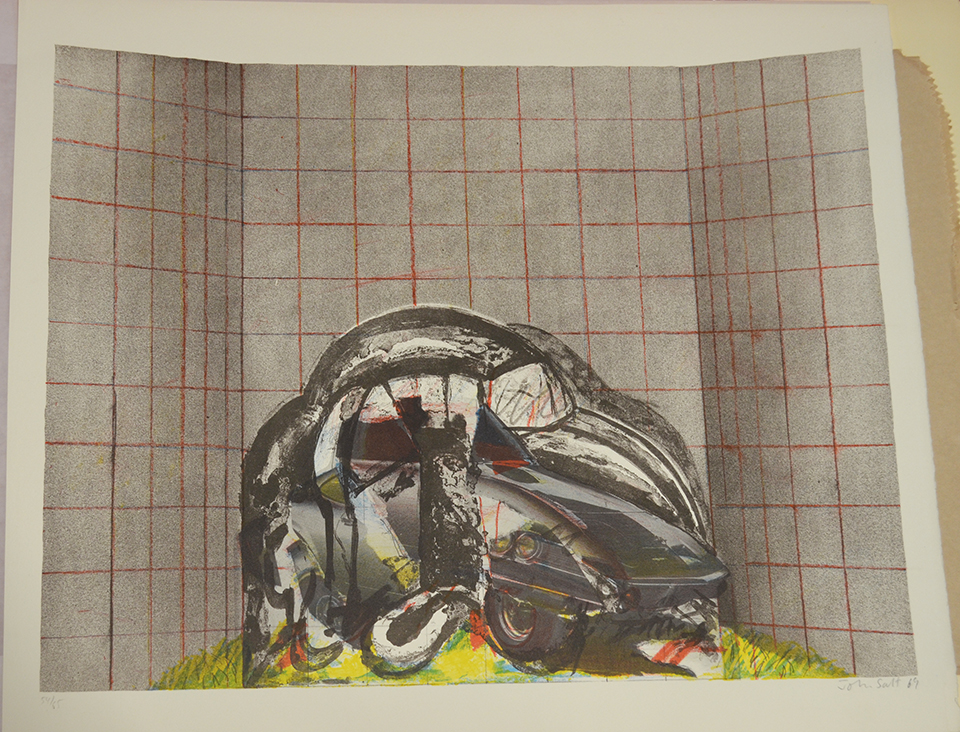
John Salt: Untitled (Wrecked Auto)
John Salt was best known as one of the pioneers of photorealism. Born and raised in Birmingham, England, Salt’s early surroundings were steeped in the aesthetics of the automobile — his father owned a motor repair garage, and his step-grandfather painted decorative stripes on car bodies. This mechanical lineage would later emerge as the visual and emotional core of his art. Encouraged to draw at a young age, Salt entered the Birmingham School of Art when he was only 15. He progressed to the Slade School of Art in London, where the influence of Prunella Clough and American Pop Art figures such as Robert Rauschenberg shaped his early vision.
Salt’s early works reflected the two dominant artistic trends of his time — Abstract Expressionism and Pop Art. While teaching in Stourbridge and exhibiting at Birmingham’s newly opened Ikon Gallery in the mid-1960s, he was still exploring where his artistic voice would resonate best within these established styles. Yet, he was discontent with the idea of adopting a ready-made lexicon, unlike the Warhols of the age. Instead, he sought a more personal language that could reconcile the magnetism of pop culture with a deeper, more observational truth.
This search intensified when Salt moved to the United States in 1967 to join the MFA program at the Maryland Institute College of Art (MICA) in Baltimore. Under the mentorship of Grace Hartigan, he was encouraged to experiment beyond stylistic conventions. In the college library, he discovered Contemporary Photographers: Towards a Social Landscape, a book that proved transformative. The direct, documentary style of photographers such as Garry Winogrand and Lee Friedlander, with their unselfconscious recording of everyday life, offered Salt an alternative to the painterly habit. He began photocopying images from the book with the intent of translating their realism into paint.
Salt’s painting Untitled (1967), closely based on Winogrand’s New York City (1959), marked his first step toward a new artistic language. The painting, depicting the interior of a car as seen from outside, restaged the photograph with near-clinical accuracy, yet still retained traces of expressive interpretation. Salt realized that the elimination of expressive “style” would demand an exact and impersonal transcription of the image.
When artist Alex Katz reviewed Salt’s work while still at MICA, he remarked, “This may not even be art.” That comment was, unexpectedly, an affirmation. Salt had found a form of painting that subverted traditional notions of authorship by erasing gesture.
Instead of returning to England after completing his studies in Baltimore, Salt moved to New York City in 1969. This relocation marked a profound shift in both subject matter and sensibility. Moving beyond the pristine interiors of consumer advertising, he began photographing the unvarnished, grimy world around him.
The decisive moment came when he discovered a scrapyard beneath the Brooklyn Bridge. The scene of twisted metal and wrecked vehicles, stripped of their showroom allure, offered a raw, anti-consumerist counterpoint to the polished imagery of his earlier work. These wrecks embodied entropy, memory, and loss. Using his photographs as source material, Salt captured vehicles mangled to the point of violence, transforming them into haunting icons of decay.
This scrapyard epiphany did more than change his subject; it reoriented his method. He began using airbrushes, stencils, and other media, refining the technical precision necessary to reproduce photographic detail while suppressing painterly trace. The resulting works—abandoned cars, mobile homes, and pickup trucks rendered with frozen stillness—blurred the line between painting and photograph.
This print is a part of the resulting experimentation after that pinnacle moment. This untitled lithograph, edition number 54 of 65, was made in 1969 in New York City, after he was influenced by the scrapyard’s monument to decay. Salt incorporates photorealistic imagery of a violently crumpled car body, with traces of painterly embellishment. The background is little more than a grid in one-point perspective, suggesting containment and isolation. Yet the green grass beneath the mangled vehicle, which is far from photorealistic, gives the deception of life still present. This print is one of many that Salt made into a series, all variations of the same mangled, functionless, dirty vehicles in a containment grid, in various colors and degrees of destruction, including aspects of photorealism and painterliness. It is one of three prints of Salt’s work in the AMA’s permanent collection.
By anchoring his art in his photographic encounters, Salt redefined realism as both document and meditation. What began as an engagement with Pop Art’s celebration of the consumer object evolved into a quiet elegy for its aftermath. Where Pop Art had glorified the new, Salt painted what was left behind.
— Katie Dillard, Director of Curatorial Affairs.
Explore more art from the Albany Museum of Art permanent collection HERE.
See more bios of artists with works in the Albany Museum of Art permanent collection HERE.