Naoto Nakagawa: Red Nails
In the early 1970s, Naoto Nakagawa (Japanese-American, b. 1944) developed a series of large-scale, sharply rendered paintings of everyday objects: combs, mirrors, scissors, and domestic items, transformed into psychologically charged compositions. In this series, he worked with Liquitex, one of the first acrylic paints made.
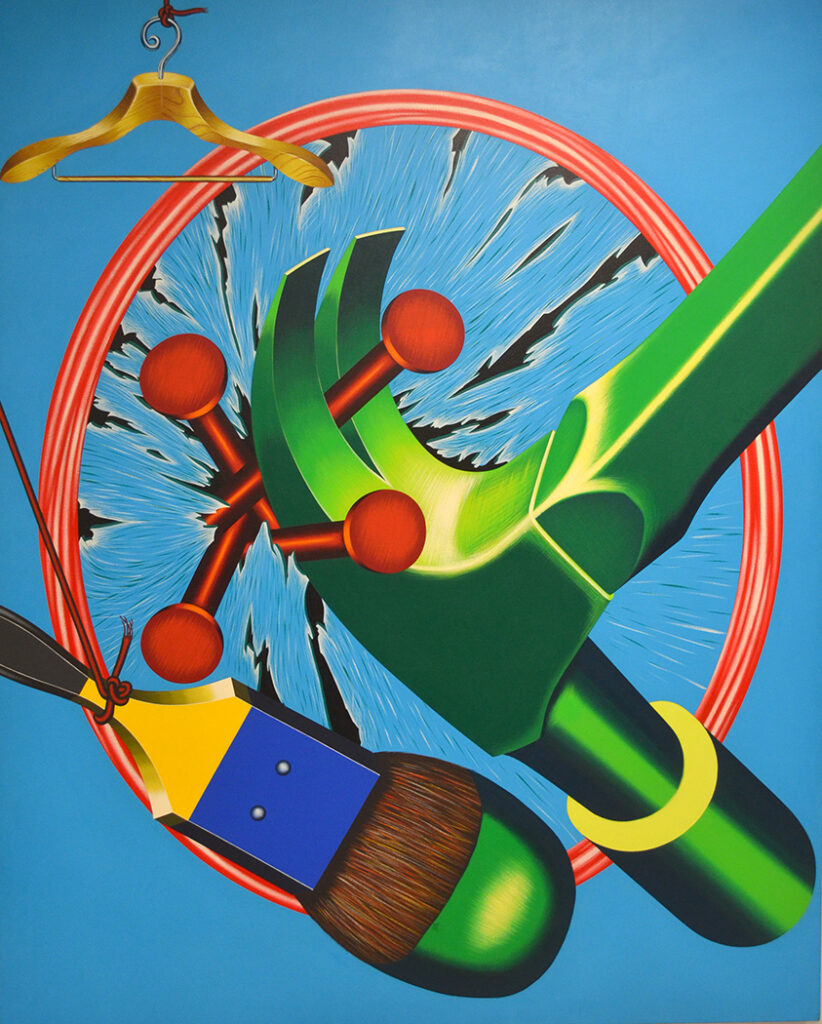
Red Nails (1971) exemplifies this early 1970s practice. The composition features a cluster of hyper-real, brightly colored objects: a glossy green hammer, a paintbrush loaded with green paint, a clothes hanger, and a radial burst resembling fractured mirror glass or an explosive force, organized within a red, circular frame on an eye-vibratingly blue background. The titular “red nails” appear as spherical nodes connected to thin rods, evoking both industrial fasteners and molecular structures.
The nails don’t seem to serve any purpose in keeping anything together. In fact, the opposite is conveyed as twisted nails emerge from shattering glass. Nothing is keeping this arrangement together except for the slender, frayed red thread, barely visible in the frame of the work, tied to both the hanger and the slim handle of the paintbrush.
This painting operates on multiple levels; its crisp edges, saturated palette, and polished surfaces recall commercial illustration and Pop aesthetics. Yet the composition resists stability: objects collide, pierce, and overlap in ambiguous spatial relationships. The circular motif suggests containment, but the explosive burst disrupts this order, introducing a sense of violence or rupture. It’s a curious mixture of objects that invokes more questions than answers.
Red Nails becomes a meditation on tension: between construction and destruction, utility and threat. Ultimately, Nakagawa’s early 1970s work reflects a broader cultural moment in New York, where artists grappled with consumerism, war, and identity. His paintings stand out for their ability to transform ordinary objects into charged, almost mythical forms, revealing the hidden emotional and symbolic weight of modern life in America.
— Katie Dillard, Director of Curatorial Affairs.
See more art from the Albany Museum of Art permanent collection HERE.
See more bios of artists with works in the Albany Museum of Art permanent collection HERE.