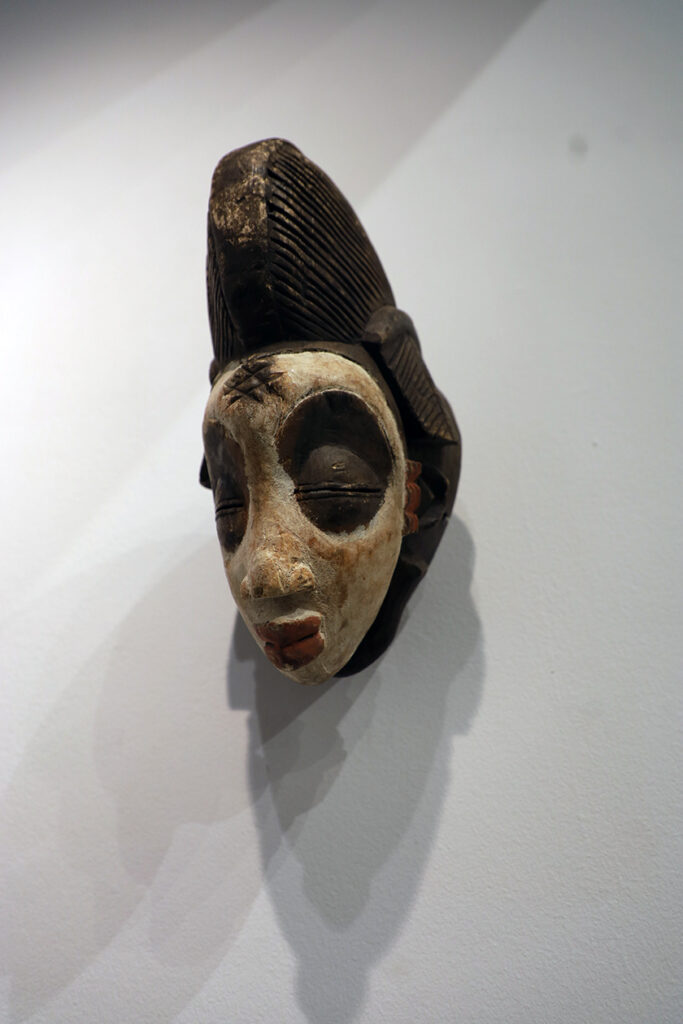
Gabonese Artist: Punu Maiden Spirit Mask
This mask from the Punu community in Gabon is one of the few museum purchases in the Sub-Saharan African collection of the Albany Museum of Art. Punu Maiden Spirit Masks share key features that denote the iconic characteristics of a spirit ancestor.
The Punu community is historically and traditionally deeply rooted in spiritual practice and ritual. Additionally, Punu culture has a matrilineal lineage, making the Punu Maiden Spirit Mask an important facet in this community’s traditions.
The Punu Maiden Spirit Mask would have typically been worn by dancers in performance or masquerade in celebration of the beautiful women in their community who have become or will become ancestors one day. The masks would have been worn by male dancers, who would take on the spirit of the maternal ancestor.
In addition to the mask, costuming would also include stilts, making the performers tower over their community, adding an element of mysticism. Punu Maiden Spirit Masks will always share several distinct features: the coiffure or hairstyle, the long forehead with scarification, eyes closed in a serene state, and the white kaolin clay surface. Each of these features is a representation of ideal beauty features or traits for women of the Punu culture.
While noting the physically beautiful features, such as hair styling and the long forehead, the mask also touches on the internal beauty through the calm and contented look of the mask, depicting a wise woman connected to the spiritual realm.
The Punu community, like many African communities and cultures, believed that their ancestors were present in their everyday lives. One would work on having the most prosperous life so they too could become an ancestor, while also doing ancestral veneration or honoring their ancestors throughout their lives in ritual practice.
The kaolin clay pigment is a key feature pointing to the importance of spiritual awareness, while the white pigment denotes that the figure being depicted is a spirit; the kaolin clay itself has a deep significance in Punu culture. Kaolin was taken from the riverbeds and thought to have healing properties, and the river itself was seen as a transitional site, almost a door to the spiritual domain.
— Sidney Pettice, Curator of African Collections and African Diasporic Art
Explore more art from the Albany Museum of Art permanent collection HERE.
See more bios of artists with works in the Albany Museum of Art permanent collection HERE.