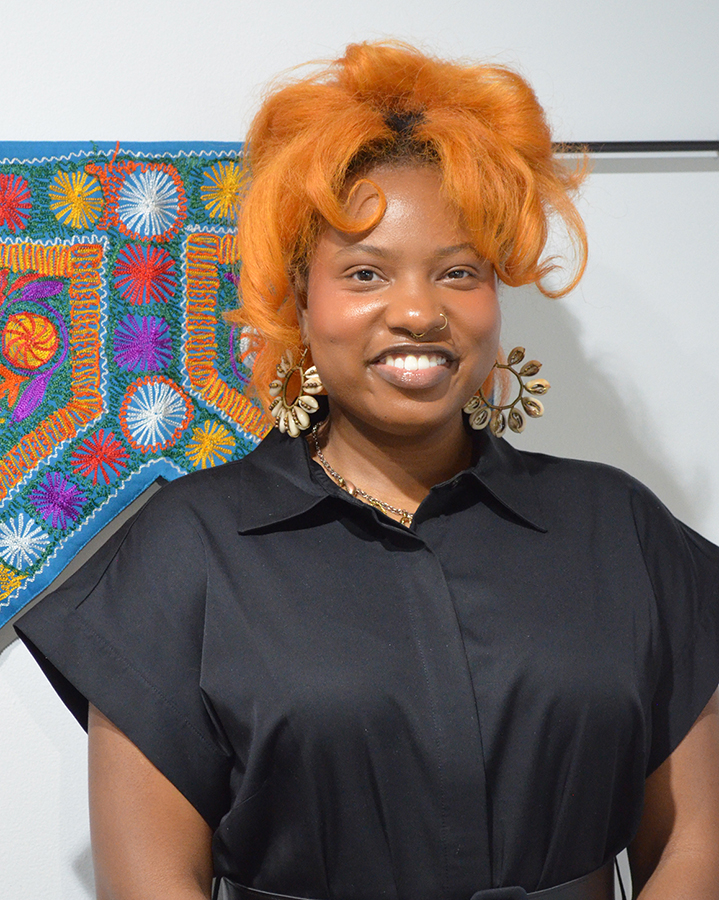
Maya Henry Is the Museum’s New Curator of African Collections and African Diasporic Art
Originally on a career track to become an attorney, Maya Henry has taken a different path, one bringing the New Jersey native to Southwest Georgia. She became the new Curator of African Collections and African Diasporic Art at the Albany Museum of Art on October 13.
Henry, who earned her Master’s Degree in Heritage Preservation from Georgia State University earlier this year, said her first impressions of Albany have been positive. “I’m still getting my bearings,” she said. “Everybody’s been so very welcoming, very kind, so that’s made the transition very easy for me.”
“We are thrilled to have Maya join us at the Albany Museum of Art,” said AMA Executive Director Andrew J. Wulf, Ph.D. “What impressed me about Maya from the beginning was her curiosity, her passion for history, and her understanding of how art can connect people across cultures and generations. She brings a fresh perspective to our remarkable African art collection, and I think her interest in the stories behind the objects will open up some wonderful possibilities for the museum and our community. I’m very much looking forward to seeing what she does.”
Since joining the AMA Curatorial Department led by Director of Curatorial Affairs Katie Dillard, Henry, whose position is endowed by the Walter & Frances Bunzl Family Foundation, has been acquainting herself with the AMA’s African art collection, the largest in the Southeast outside a university setting.
“It has been a pleasure to welcome Maya to the AMA as our new Curator of African Collections and African Diasporic Art,” Dillard said. “She is already hard at work developing exhibitions for upcoming seasons and getting to know the AMA’s permanent collection. I’m excited to see how Maya’s diverse experiences, background, and expertise will enrich our exhibitions, bring fresh perspectives to the interpretation of the permanent collection, and contribute to the continued growth of our curatorial department.”
Henry said the focus on African diasporic art was a major factor in her decision to apply for the position at the AMA. “My approach to collections and my approach to history are very Pan-African, so it is important to me that when I look at the work of African peoples and people in the diaspora, we look at the art within the context it was made,” she said. “If you’re of African descent and you’re working in Trinidad, the United States, or Jamaica, you’re an African person creating art and part of that collective diaspora.”
“It’s important to me that works from the continent of Africa are in conversation with other people in the diaspora, and that they’re speaking to each other. They’re not in colonial, isolated borders and boxes.”
Originally, Henry planned to pursue a law career focusing on education or civil rights. She was doing advocacy work for LGBTQ communities while studying political science and education. She decided she needed to know what it was like to teach before developing education policies.
After earning her Bachelor of Arts in History and Education with a minor in Gender and Sexuality Studies from Swarthmore College in Swarthmore, Pa., in 2020, she taught middle school social studies for four years at Sankofa Freedom Academy Charter School in Philadelphia. She also served two summers there as an academic advisor for the academy and the Ujima Friends Peace Center.
“I switched to teaching because my education classes were invigorating. I had the opportunity to gain the language necessary to understand the disparities present in our system and conduct research related to class and race. This made me passionate about teaching and supporting education initiatives that benefit students, holistically.”
She also had early exposure to museums as a child that continued through adulthood. “I always loved museums,” Henry said. “Every time we went somewhere growing up, my mom made sure we always went to a museum. She made that a normal part of my life, so that is something I did as an adult.”
Still, she never entertained the idea of actually working in the museum field until she was in an entirely different kind of field.
“I was on an organic ginger and turmeric farm for two weeks in Virginia—random side quest in my life,” Henry said. “I took a trip with the family I was with to the National Gallery of Art, and I saw Afro-Atlantic Histories. It was curated by Adriano Pedrosa and Kanitra Fletcher, and it was art from all over the diaspora in one large exhibition. That was the first time I went to a museum and felt like, ‘Oh, I know what they’re talking about.’”
She had taken college classes about Black women and spirituality, Yoruba, religion, African traditional religions, and African-American history, but had not seen her pan-African diaspora interests reflected in museum exhibitions.
“It was out there, but it just had never been my experience in a museum setting,” Henry said. “When I went to that exhibition, it was like, oh, I actually recognize these pieces. This is speaking to academic courses I’ve taken. It’s speaking to my personal experience. It’s speaking to my family. It’s speaking to someone I know and have talked to. It resonated deeply within me.”
While she was interested in other career avenues, her exposure to Afro-Atlantic Histories instilled something new—a strong desire to pursue a specific new direction. “This was the first time I said, ‘I want to do that, and I want to understand what a curator does and what that is. I want to know how they put this together.’ That was the catalyst for me to go back to school,” she said.
Henry returned to the classroom and, earlier this year, earned her Master’s Degree in Heritage Preservation from Georgia State University. She was a community outreach graduate research assistant from 2024 to 2026 at the Georgia Department of Community Affairs Historic Preservation Division in Brookhaven.
In 2025, she served as a Roger Kennedy Scholars intern with the Smithsonian National Museum of American History in Washington, D.C., where her duties included collaborating with curators, museum staff, and external partners on exhibition planning, interpretation, collections care, evaluating objects, maintaining records, and supporting the preservation and organization of materials.
At the Smithsonian, her primary project work contributed to a 2027 mid-career retrospective exhibition for quilt artist Bisa Butler at the Smithsonian American Art Museum titled Bisa Butler: Tender Monuments. Henry worked on the reattribution of a quilt made by two formerly enslaved women in Kentucky, Ellen Morton Littlejohn and Margaret Morton Bibb that will be exhibited along with Butler’s work. She supported the genealogical research and reviews of primary and secondary sources to further the reattribution process and uncover more information about the women’s lives.
As curator, she will preserve and show objects that connect the present to the past through art that comes in many forms.
“I have a large interest in textiles—patterns, fabrics, materials, and color,” Henry said. “I love fashion, wearable art, and art that has deep personal meaning or that is connected to family history. I love to hear about people’s family, their stories, and why things are important to them.”
An example, she said, is an artifact within her own family—a vintage Singer sewing machine table that belonged to her great-grandmother.
“I did a project about my great-grandmother’s sewing machine that my dad still has, a Singer sewing machine,” Henry said. “Growing up, his grandmother made all of his clothes and his siblings’ clothes. That sewing machine survived Hurricane Katrina, and my dad took it, and he got it restored. Now, he has family photos displayed on it.”
“I look at the sewing machine, and I think that it is an altar because of the family pictures. No one’s allowed to touch it; it’s like a sacred object, in a way. He says it’s a conversation piece, an art piece. Both are true, but they mean something important to us for slightly different, and similar, reasons. That is why I am interested in curatorial work, because it is this simple object many of us can relate to, but we have this very deep, personal connection to the piece. It generates all these stories in our minds, and I find that exciting.”