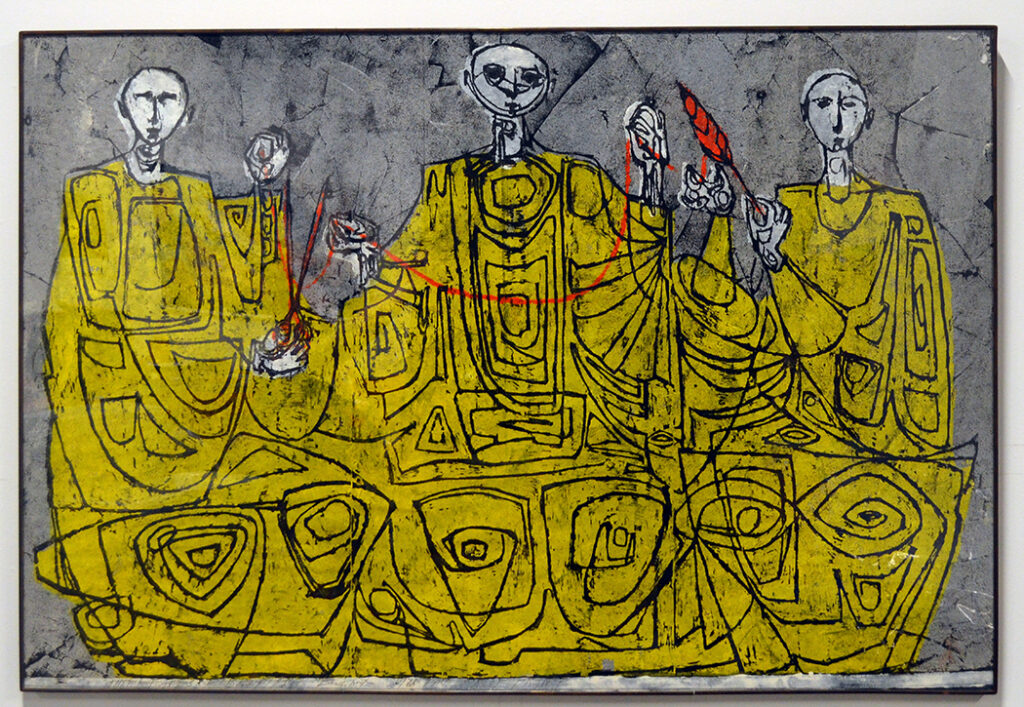
Gifted to the AMA in 1983, this large-format woodcut relief print depicts the Three Fates from Greek mythology. Known as the Moirai, meaning “allotted portion” or “shares,” the three sisters were said to control the life and destiny of every human being.
Often depicted as older women working with thread, the Fates each had a name and a specific role. Clotho (“the spinner”) spun the thread of life, representing the beginning of a person’s existence or birth. Lachesis (“the allotter”) measured the thread, determining the length of the person’s life and the events that would shape their destiny. Atropos (“the inflexible”) cut the thread with her shears, bringing the person’s life to an end. Her decision was final and irreversible. Even the gods could not change their decisions.
Together, the three sisters symbolized the cycle of life: birth, the course of one’s life, and death.
It’s curious that Ben Smith (1941–2021), an Atlanta-based artist making his name in the early 1960s, would depict the Three Fates at a timely moment in his career. He is best remembered for his monumental woodcut prints that pushed the traditionally intimate medium of woodcut to an almost architectural scale. Some of his prints measured up to 15 feet long, an extraordinary size for a relief print. Learn more about the artist HERE.
The Three Fates, created in 1968, is the largest woodblock print in the AMA’s permanent collection. Measuring 32 1/4 by 47 3/4 inches, it rests in a heavy-duty metal frame with no matting or extra flourishes whatsoever.
The bright yellow ink of the sisters’ dresses contrasts starkly against the charcoal grey background. Above the looping lines and shapes present in the yellow dresses, their pale grey faces seem neutral, genderless, and alien, gazing forward as though it’s the viewer’s turn to be judged. In the center, the eye-catching red thread of a life is held delicately and balanced between the three sisters. There is tension here, at the pinnacle moment before Atropos, on the left, decides to snip the thread.
Additionally, this work is an FMP, or an artist’s proof. Historically, these were the initial test prints pulled to check the overall quality of the print, making them rarer in the market. Artist proofs would have unique features differing from the final print; each print would be a calibration towards the final image. Artists and/or printers would only need to make so many of the FMPs before the quality was determined to be what the artist intended. Then, the woodblock (or other printing matrix) would remain unaltered as it was used to produce a specific quantity of exact replicas of the intended print.
This donation marks one of many successful outreaches coordinated by AMA volunteers and staff in the early days of the “new museum,” which opened in 1983 at its current Meadowlark Drive location. It was through the unending efforts of volunteers and staff, and the relationships they built with donors, that the AMA’s collection grew rapidly during this time.
— Katie Dillard, Director of Curatorial Affairs.
See more art from the Albany Museum of Art permanent collection HERE.
See more bios of artists with works in the Albany Museum of Art permanent collection HERE.