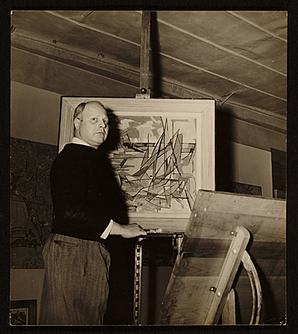
Carl Holty (1900–1973) occupies a vital place in the development of American abstraction, bringing a sense of lyricism and quiet rigor to the evolution of modern painting. Though raised in Wisconsin and initially trained in the United States, it was Holty’s formative years in Paris, France, during the late 1920s and early 1930s that profoundly shaped his artistic vision.
Upon returning to the United States, he found artist representation in New York City and became involved, once again, with Hans Hofmann, who he trained under in Munich in the late 1920s, and Vaclav Vytlacil as well as Stuart Davis, whom he had known in Paris.
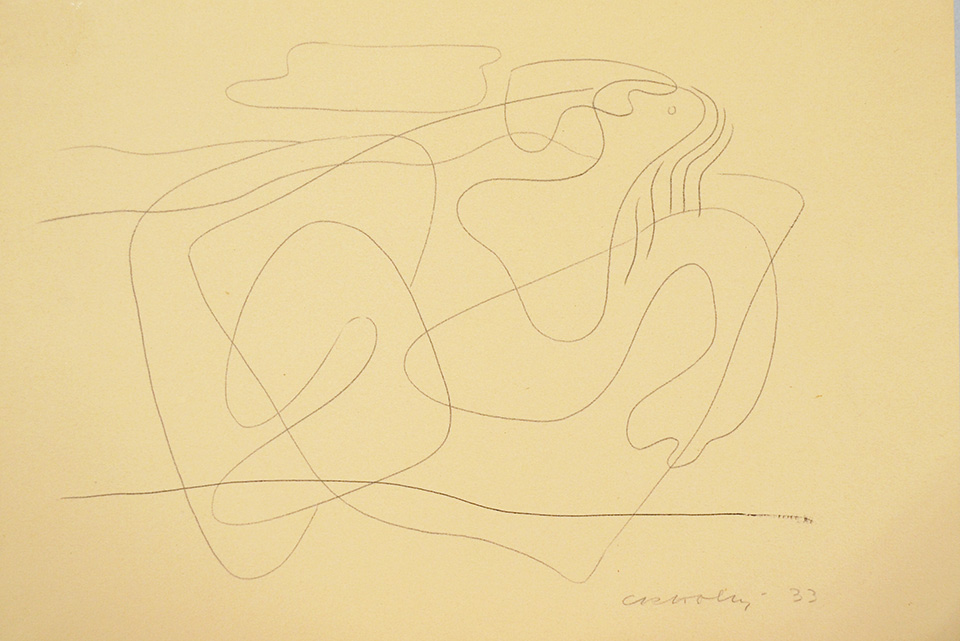
Holty participated in discussions that led to the American Abstract Artists, which he would chair. He moved away from Cubism and experimented with Biomorphism. In the 1930s, he used tape to give forms strong edges. He continued to explore shapes and form, and by the 1960s contours had disappeared from his work, being replaced with subtle colors.
He served as an artist-in-residence at Georgia State University, the University of Florida, the University of California at Berkeley, the University of Wisconsin, and the Corcoran School of Art. He also worked with Romare Bearden on his book The Painter’s Mind, published in 1969.