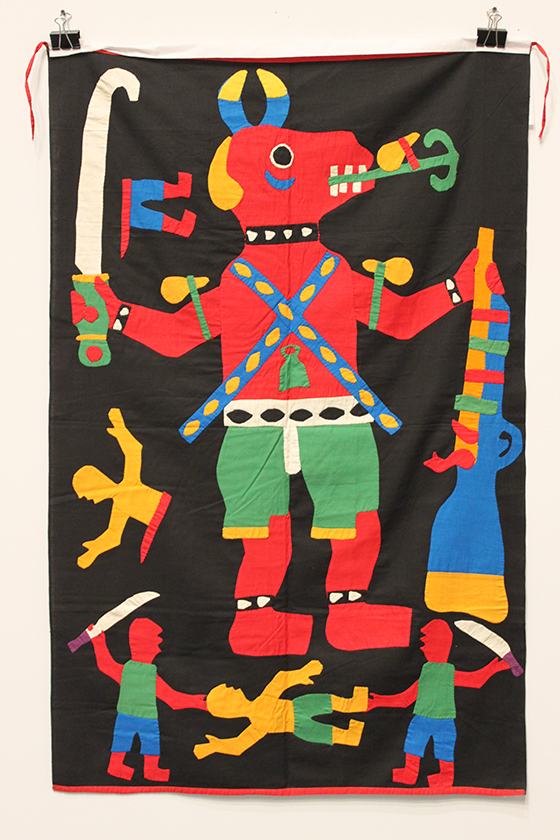
Fon Artist: Applique Banner
This textile in the African Collection of the Albany Museum of Art depicts an event that significantly impacted the history of the Kingdom of Dahomey, located in what is now Benin in West Africa. It was made by an early 20th-century Fon artist who was in an artist guild that produced custom textile banners, often for kings and their royal courts.
Each of the kings who ruled over the Dahomey Empire was represented by a distinct symbol, often an animal, plant, or tool of some kind. These symbols highly represented their personalities, and how they ruled over the Dahomey Kingdom.
This textile is representative of King Glele, who ruled the Kingdom of Dahomey from 1858 to 1898. King Glele was given the symbol of the lion because of his fierce, fearless personality and leadership.
One of his biggest achievements was leading the Dahomey Kingdom to victory in a long war against the neighboring Yoruba peoples. This banner tells the story of that victory.
Rather than his normal representation as a Lion, here King Glele is represented as the West African deity called Hevioso or Daghesu, depending on their visual characteristics.
In this applique banner, King Glele is represented as Daghesu, an anthropomorphic ram-like creature. The god of thunder, rain, and lighting. he is usually represented as this ram and human hybrid creature who carries a ceremonial axe and blade that comes out of his mouth, indicative of his power and high regard in West African beliefs. This representation indicates his strength and godly nature, as he also appears larger than all his fighting subjects and their opponents. In this applique banner, his opponents are the yellow figures, and his subjects are the armed red figures who fight their way toward victory.
Throughout the Dahomey Empire, the kings often worked to maintain an economy of trade with European people who sought to colonize African communities. The Kingdom of Dahomey is best known for its work in the sales of palm oil and other organic products alongside the sales of people into the transatlantic slave trade. While working to maintain their kingdom retaliating against European forces facing their own community, the Dahomey also were a driving force in the damaging, tragic events of enslavement and the involuntary transportation of African people to the Americas, which had a lasting impact.
With its vibrant color and dynamic art style, this applique banner acts as a time capsule for the Dahomey Kingdom and its empire, both its triumphs and difficulties as a community. With a deep use of symbolism, this textile work tells the story not only of King Glele, but also of his predecessors and those who ruled after him.
— Sidney Pettice, Curator of African Collections and African Diasporic Art
See more art from the Albany Museum of Art permanent collection HERE.
See more bios of artists with works in the Albany Museum of Art permanent collection HERE.