Naoto Nakagawa (Japanese-American, b. 1944) is a New York-based painter whose work is a highly distinctive blend of realism, surrealism, and Pop-inflected imagery. Born in Kobe, Nakagawa immigrated to New York City in 1962 and quickly became embedded in the city’s experimental downtown art scene, studying at the Brooklyn Museum Art School and exhibiting as early as 1968 at Judson Gallery.
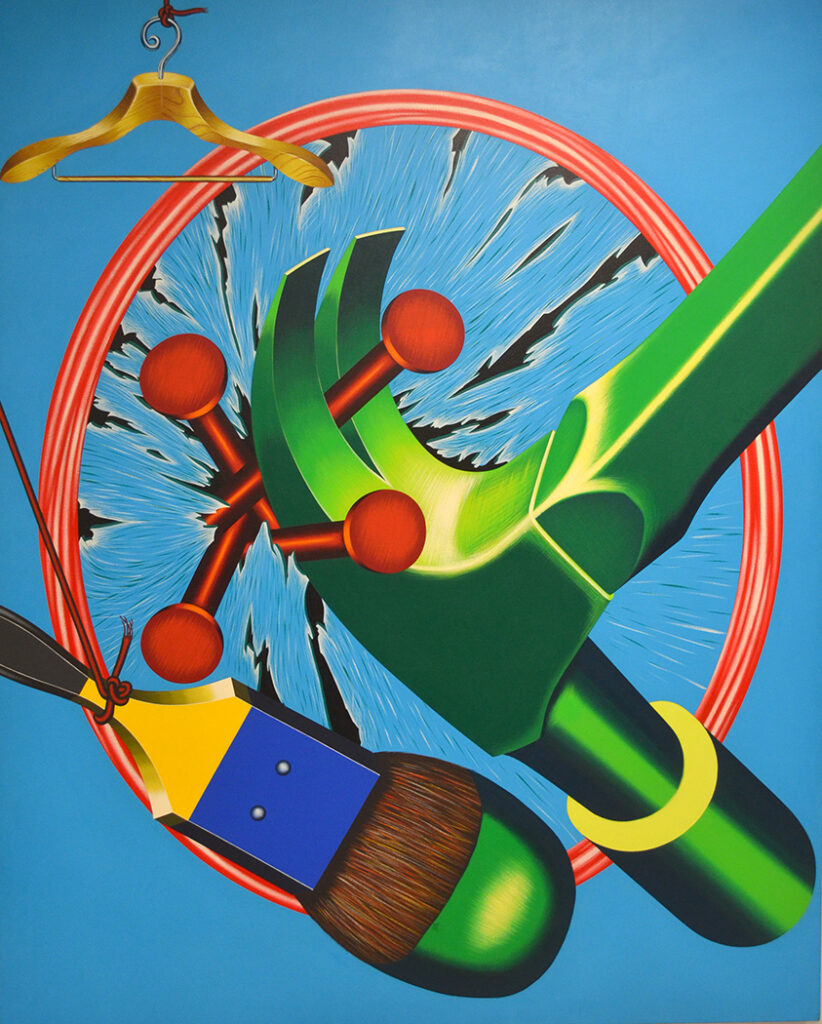
Unlike the cool detachment of most Pop Art, Nakagawa’s paintings from this era are visually aggressive, often depicting domestic objects in states of tension, collision, or transformation. These works reflect not only the visual language of consumer culture, definitive features of Pop Art, but also some of his personal background.
Nakagawa’s grandfather was one of the most revered traditional landscape painters in Japan, yet he admired painters like Willem de Kooning and Mark Rothko. As a teenager, he studied with Kikonami Joji, one of the leaders of the Gutai group, an avant-garde movement in Japan that placed emphasis on action painting and whose influences predated both Conceptual Art and Performance Art in the United States. These early influences from both Eastern and Western origins held an enormous impact on how Nakagawa would approach his artistic practice while living in New York.
In the early 1970s, Nakagawa developed a series of large-scale, sharply rendered paintings of everyday objects: combs, mirrors, scissors, and domestic items, transformed into psychologically charged compositions. In this series, he worked with Liquitex, one of the first acrylic paints made. The paint has high color values that resist dulling, and 55 years after the work was made, the paint colors remain vividly alive.